From AI code to merged PR: closing the last mile
AI coding agents are good at writing code and opening PRs. The part nobody talks about: what happens after. bellwether closes that loop.
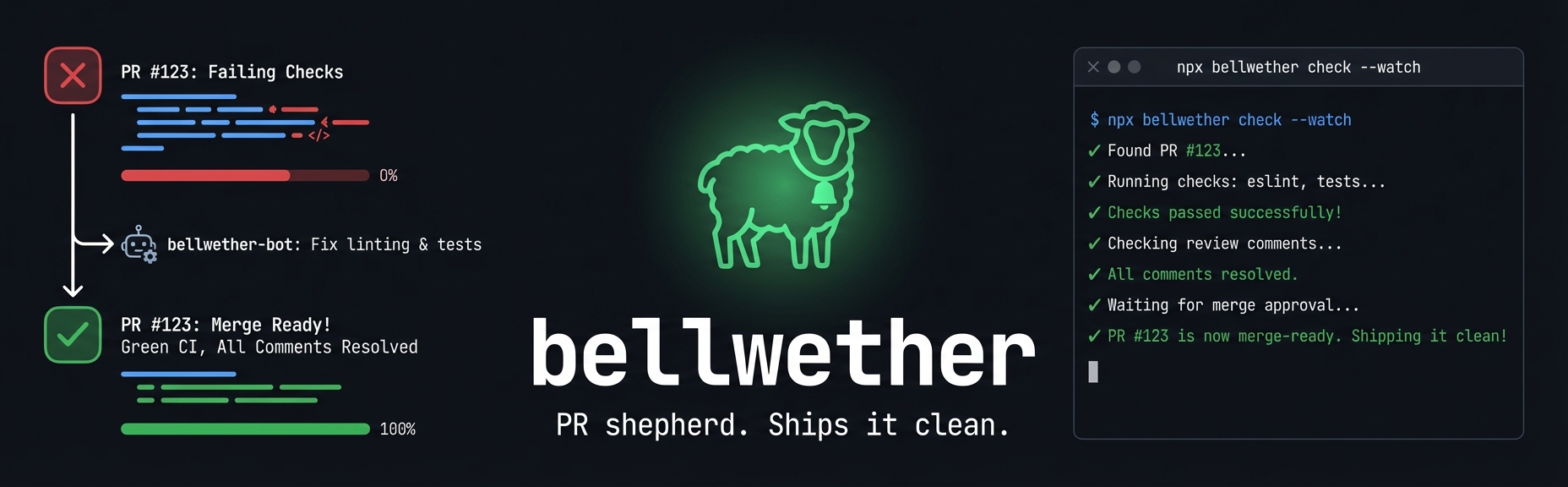
AI coding agents have gotten remarkably good at writing code. You describe a feature, Claude Code or Cursor writes it, opens a PR. Done, right?
Not quite.
The PR is open. CI is running. A reviewer leaves a comment. And suddenly you’re back at the keyboard — refreshing GitHub, reading logs, copying error messages into a new prompt, waiting for the agent to fix things, then doing it all again.
The agent handled the hard part. You’re doing the grunt work.
This is the last-mile problem in agentic coding, and it’s why I built bellwether.
What the loop actually looks like
Here’s the typical flow when an AI agent opens a PR:
- Agent writes code, opens PR
- CI runs — you wait
- CI fails — you read the logs, find the actual error buried in the noise, paste it into the agent prompt
- Agent fixes it, pushes — you wait again
- Reviewer leaves a comment — you read it, summarize it, paste it in
- Repeat until green
Each step is a context switch. Each “copy error from GitHub, paste to agent” is manual plumbing that shouldn’t exist.
The agent is capable of handling this loop autonomously — it just doesn’t have clean access to the state it needs.
What bellwether does
bellwether is a TypeScript CLI that reads your PR’s current state and returns it in a structured, token-efficient format:
npx -y bellwether@latest check --watchOutput:
pr:
  state: open
  mergeable: clean
  ready: true
ci:
  sha: abc1234
  checks: "3 total, 3 passing, 0 failing, 0 pending"
  passed: "build, lint, test"
reviews:
  total: "0 unresolved, 0 unanswered"
When CI fails, you get the actual error — not the raw GitHub API payload, just what failed and where:
ci:
  FAIL build: "TypeError: Cannot find name 'fetch' at src/client.ts:12"
--watch blocks until CI completes and the PR reaches a terminal state. No polling loop in your script. No refreshing the browser.
The watch loop
The mental model is simple:
check --watch
  → pr.ready = true?   → done ✓
  → CI failing?        → show filtered error logs
  → Unresolved review? → show comment with context
  → Merge conflict?    → sync branch needed
Your agent runs this, reads the output, knows exactly what to fix, pushes a commit, and runs it again. The loop is tight. The signal is clean. No browser required.
Design decisions
Token efficiency over completeness
The GitHub Checks API is verbose. A single failed check run returns megabytes of JSON containing build metadata, timestamps, step names, environment variables — and somewhere in there, the actual error.
bellwether queries Check Runs, fetches job logs, and filters down to the actionable signal: compiler errors, test failures, the lines that actually matter. Raw API responses are expensive for agents to process. Focused output isn’t.
This was directly inspired by RTK — a token-efficient CLI proxy that does the same thing for git and other dev tools. If you’re not using RTK alongside bellwether, you should be.
Standing on shoulders: agent-reviews
The core idea — that an AI agent should be able to read, respond to, and resolve PR review comments autonomously — comes directly from agent-reviews by @pbakaus. That project showed the pattern works. bellwether takes it further by integrating it into a full watch loop alongside CI and merge state, but the insight is his. Worth reading if you want to understand the problem space.
Clean signal, not automation
bellwether doesn’t try to fix things. It tells you what’s broken in a format your agent (or you) can act on. The agent decides what to do.
This is a deliberate choice. Automated PR fixers that also decide what to change are a different category of tool — and a much more dangerous one. bellwether is an observation layer. It composes with whatever agent or workflow you’re already using.
Works for humans too
check --watch is just a nicer way to monitor a PR than refreshing GitHub. The agent-first framing is the primary use case, but the tool is useful without an AI agent in the loop. No magic mode required.
Review comment handling
bellwether surfaces unresolved review comments with file and line context. You can also reply and resolve inline:
# Show unresolved comments
npx -y bellwether@latest check --unresolved

# Reply to comment 456 and mark it resolved
npx -y bellwether@latest check --reply "456:Fixed in abc1234" --resolve
For agents, this means the full review cycle — read comment, understand context, fix code, reply, resolve — can happen without a human touching GitHub.
Installing as a Claude Code skill
bellwether ships as a Claude Code skill. One command installs it into your local Claude Code context:
npx -y bellwether@latest skills addOnce installed, Claude Code knows the full bellwether loop: watch CI → fix failures → address reviews → push → repeat until pr.ready = true. It’s available on the Claude Code marketplace as well.
The dual-mode design (CLI for humans, skill for agents) means the same tool works in both contexts. You’re not maintaining two separate integrations.
Hooks: zero-friction PR feedback
Once you’ve installed the skill, bellwether adds Claude Code hooks that trigger automatically after common git operations:
- After
git push— immediately checks CI and review state on your PR - After
gh pr create— checks the new PR’s initial state - After
gh pr ready— confirms it’s actually ready before you notify reviewers
The hook runs npx -y bellwether@latest hook-check --format json and feeds the result back into Claude Code’s context. Your agent doesn’t need to remember to check — it happens automatically every time you push.
This is the part that makes the loop feel tight. No manual check --watch invocation between pushes. Push → CI state appears → agent decides what to do next.
Where it’s headed
bellwether is early — v0.0.6, a few days old. The core watch loop works. What’s next:
- Auto-merge on ready: once
pr.ready = true, optionally trigger merge - Multi-PR mode: watch several PRs at once, surface only the ones that need attention
- Better log filtering: smarter signal extraction from more CI providers
If you’re working on agentic coding workflows and hitting the same last-mile friction, I’d genuinely like to know what your setup looks like. Issues and PRs welcome.
GitHub: github.com/roderik/bellwether npm: npmjs.com/package/bellwether
# Try it now — no install needed
npx -y bellwether@latest check